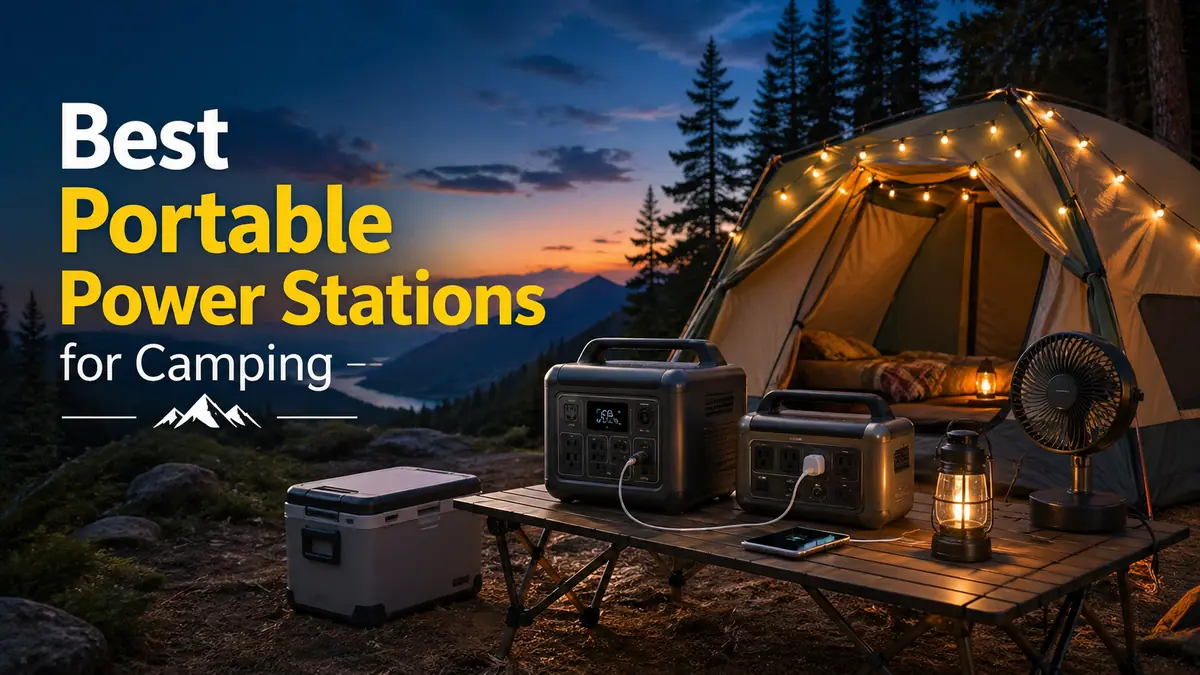
A camping power station has a different job from a home-backup unit. At a campsite, the winning model is usually the one that is easy to carry, quiet during evening use, simple to recharge between trips, and large enough to cover the exact mix of devices you bring. That usually means lights, phones, a fan, camera batteries, a small cooler, or a CPAP machine rather than heavy kitchen appliances or whole-room comfort loads.
The mistake many buyers make is shopping by the biggest battery number they can afford. Bigger is not always better when you are loading the car, walking to a tent site, or trying to keep your setup compact. For camping, good buying logic starts with trip style, device mix, runtime expectations, and how realistic solar or car charging will actually be once you leave home.
This page is built to help you choose the right type of portable power station for camping without overbuying. It explains what makes a model camping-friendly, how much battery most campers actually need, where solar helps, when a generator is unnecessary, and which scenarios justify moving up in size. If you want the broader category view first, start from best portable power stations.
What Makes a Portable Power Station Good for Camping?
A good camping power station balances six things better than a generic backup unit: weight, usable capacity, enough inverter output for the devices you really use, practical charging options, low-noise operation, and simple campsite safety. The right model should feel easy to live with before, during, and after the trip.
For camping, portability matters more than it does in many home-backup situations. Even if you are car camping, you still need to unload the unit, place it somewhere sensible, protect it from weather, and move it around camp if your setup changes. Once a unit becomes awkward to lift or annoying to pack, its extra capacity starts to feel less valuable.
Camping also rewards quiet power. Battery stations are easier around shared campgrounds because they avoid fuel storage, fumes, and the sound profile of a generator. That does not mean every model is equally pleasant to use, though. Cooling fan behavior, port layout, charging noise, and lighting features can all affect the ownership experience. If noise is high on your checklist, the supporting page on quiet portable power stations is the best next read.
How to Choose the Right Camping Power Station
The fastest way to choose well is to match the station to your camping style first, then refine by battery size and charging method. Tent camping, car camping, CPAP use, and camping with an electric cooler all change the answer.
Trip Type — Tent Camping vs Car Camping
Tent campers usually benefit from smaller, lighter units that cover essential electronics and basic overnight comfort. If you carry the station any meaningful distance, low weight and simple handling become major priorities. Car campers can usually tolerate larger units because the vehicle absorbs most of the transport burden, which opens the door to more capacity and more ports.
That difference matters because the same unit that feels perfect for a trunk-based weekend setup may feel oversized and wasteful for a minimalist tent trip. Entry-level buyers who mostly need lights, phones, and occasional fan use will often land in the same range covered by best portable power stations under $500.
| Camping Type | Typical Devices | Recommended Battery Range | Notes |
| Minimal tent camping | Phones, lanterns, headlamps, camera batteries | 300–500Wh | Best when carry weight matters most. |
| Comfort-focused tent camping | Phones, lights, fan, tablet, small CPAP use | 500–800Wh | Better for two-night trips with moderate overnight draw. |
| Car camping | Phones, lights, fan, laptop, camera gear, cooler support | 500–1000Wh | Good balance of flexibility and manageable size. |
| Power-heavy campsite setup | Cooler, CPAP, laptops, extended weekend loads | 1000Wh+ | Only worth it when the device mix truly needs it. |
Capacity — How Much Battery Do You Need?
For camping, watt-hours are usually more useful than marketing labels. A small station can still feel excellent if it covers your actual loads for the length of the trip. For many campers, the best range is not the biggest one but the smallest range that fully protects phones, lights, fans, and any overnight device you cannot do without.
A practical way to think about sizing is this: lighter one-night and two-night trips usually reward 300–500Wh models; mixed-use weekend trips often sit more comfortably in the 500–1000Wh class; and heavier setups with coolers or sensitive overnight loads can justify 1000Wh or more. If you want a full sizing framework beyond the camping lens, the dedicated guide on what size portable power station you need should be your next step.
Output — What Devices Do You Need to Run?
Battery size alone does not decide whether a station can run your gear. You also need enough inverter output. That is why some buyers choose a unit that looks large enough on battery capacity but still cannot handle the startup demand or continuous wattage of the device they planned around.
This matters most for camping coolers, heated accessories, cooking appliances, and anything with a meaningful surge requirement. Phones, lights, battery chargers, and small fans are usually much easier. Before buying up in battery size, make sure the unit can actually power the device mix you have in mind. For device-by-device planning, use how long a portable power station will run alongside the output specifications on the product page.
Weight and Carryability
Carry weight is one of the most underrated parts of camping comfort. A station can look excellent on paper and still become the thing you least enjoy moving. For tent camping, every extra kilogram changes convenience. For car camping, weight still matters when loading the trunk, reorganizing the site, or packing up in bad weather.
As a rule, if you hesitate to move it with one hand or do not enjoy picking it up with two, you should be certain the runtime gain is worth that tradeoff. That is why many of the best camping picks are not the largest models in the category.
Charging Options — Wall, Car, and Solar
Most camping owners recharge from the wall before departure, then top up in the car or with a solar panel when needed. That makes charging speed and input flexibility more important than many buyers expect. A station that charges quickly at home is easier to prepare for last-minute trips, while car charging is useful on the road but rarely dramatic enough to fully replace a wall charge.
Solar support is valuable, but it should be treated as an extension tool rather than magic refueling. Weather, panel size, daylight hours, panel angle, and the station’s own solar input limits all change the result. Solar is usually excellent for stretching a trip, offsetting daytime fan or charging use, or slowing the battery drain. It is less impressive when buyers expect a small panel to erase overnight consumption by itself. The fuller planning framework lives in the solar charging guide for portable power stations.
Noise, Safety, and Campground Practicality
Portable power stations fit camping culture well because they are quieter, simpler, and cleaner to use than generators. They avoid fuel handling and usually feel more compatible with shared campsites, family trips, and quiet-hour expectations. That makes them especially attractive when your goal is practical convenience rather than high-power tool or appliance use.
They also reduce friction. You charge them, carry them, press a button, and use the ports you need. For many campers, that low-friction setup is the real product benefit.
Best Portable Power Stations for Camping by Scenario
The best camping power station depends on the kind of trip you take. Scenario-based buying is more useful than one oversized “best overall” answer because camping setups vary so much.
Best for Tent Camping
The best tent-camping pick is usually a light, compact model with enough battery for phones, lights, headlamps, camera charging, and maybe a small fan. In this lane, ease of carry and simple operation matter more than maximum battery size. A 300–500Wh class unit is often the cleanest fit if your overnight setup is modest and your trip length is short.
This kind of station works best when you want reliability without turning your campsite into a gear-heavy setup. Buyers who mostly do simple weekend trips should not feel pressure to size up too early.
Best for Car Camping
The best car-camping pick usually moves into the 500–1000Wh range. Car campers can justify extra battery and more ports because transport is easier and the device mix often grows: lights, phones, a fan, camera batteries, laptops, and occasional cooler support all start to add up.
This is often the value sweet spot because you get clearly better flexibility without automatically jumping into large, expensive, awkward-to-lift systems.
Best Lightweight Pick
The best lightweight camping pick is the model you will actually bring on every trip. That usually means a compact unit with enough runtime for essentials rather than an ambitious all-purpose backup box. The tradeoff is simple: you gain carry comfort and setup ease, but you give up runtime headroom.
For many buyers, that is still the better trade. If price matters as much as mobility, the under-$500 shortlist is often where the best lightweight options cluster Best portable power station under 500 usd.
Best for Weekend Trips
A strong weekend-camping pick usually needs enough battery to get through two nights of normal use without constant anxiety. That often means enough reserve for phones, lights, a fan, camera gear, and some buffer for convenience charging during the day. The 500–1000Wh class usually fits this job better than very small starter units.
Weekend buyers should care about recharge speed, too. The faster the wall recharge before departure, the easier the station is to keep ready between trips.
Best for Camping With Solar Panels
The best solar-friendly camping pick is the one with realistic solar input support, not just solar-compatible marketing. For camping, that means a station that can accept enough panel input to make daytime charging worthwhile, while still being small enough to suit the trip.
This setup works best for campers who spend enough time in one place to deploy panels properly and who want to stretch runtime rather than replace all other charging methods. It is usually a support strategy, not a reason to ignore base battery sizing.
Best for CPAP Camping
The best CPAP camping pick prioritizes quiet operation, stable power delivery, and realistic overnight runtime. This is one of the few camping scenarios where reliability matters more than convenience features. Buyers should think carefully about humidifier use, expected therapy hours, and whether the model offers the clean output profile they want for sensitive overnight use.
If this is your primary use case, go deeper on best portable power stations for CPAP before comparing shopping-page claims too casually.
Best for Camping Fridges and Coolers
The best fridge-or-cooler camping pick usually needs more battery and more output confidence than a normal comfort-focused camping setup. Electric coolers and small fridges can push buyers out of the lightweight tier surprisingly fast, especially on longer trips.
That does not always mean you need a huge station, but it does mean runtime math matters more. Before buying, compare the device draw against the station size and use the full runtime planning page on how long a portable power station will run .
What Size Portable Power Station Is Best for Camping?
The best camping size depends on whether you are buying for convenience, overnight comfort, or higher-draw campsite equipment. Most casual campers do well in the 300–500Wh range if their needs are basic. A broad middle of weekend and car campers often gets the best balance from 500–1000Wh. Sizes above that become more justified when cooler support, longer trips, or CPAP reliability are part of the plan.
The key is to size around the device mix you actually use, not around fear of running out once in a rare edge case. If you are unsure, build your answer around the separate size guide first, then return to the camping shortlist with a narrower range in mind.
| Device | Typical Watts | 300–500Wh | 500–1000Wh | 1000Wh+ |
| Phone charging | 5–20W | Easy for repeated charging | Easy with broad margin | Overkill unless many devices |
| LED campsite lights | 5–15W | Strong fit | Excellent fit | Excessive for this load |
| Portable fan | 20–60W | Short to moderate support | Better overnight support | Strong multi-night support |
| Laptop | 45–100W | Moderate use only | Good fit for mixed use | Comfortable buffer |
| CPAP | 30–90W | Only some setups fit | Often the safer camping range | Best when reliability matters most |
| Electric cooler / mini fridge | 45–80W+ cycling | Usually limited | Possible with careful planning | Best for longer cooler use |
For the full sizing breakdown beyond camping-specific examples, use what size portable power station you need.
Portable Power Station vs Generator for Camping
For most modern campers, a portable power station is the more pleasant tool. It is quieter, cleaner, easier to use, and far more compatible with campgrounds and family-style trips. A generator still wins when the job genuinely demands much higher sustained output or much longer runtime without practical recharge access.
That means the real question is not which category is universally better. It is which category solves your campsite problem with less friction. If your goal is lights, charging, fan support, cooler assistance, or CPAP power, a battery station is often the smarter answer. If your goal is to run power-hungry heating or cooking equipment for long periods, the balance changes.
| Factor | Portable Power Station | Generator | Better for Camping? |
| Noise | Low to very low | Usually much louder | Portable power station |
| Fuel / fumes | No fuel, no exhaust | Needs fuel, produces exhaust | Portable power station |
| Campground friendliness | Usually easier for shared sites | More restricted or less welcome | Portable power station |
| Ease of use | Simple push-button operation | More setup and fuel handling | Portable power station |
| Very high-output loads | Limited compared with fuel models | Stronger heavy-duty ceiling | Generator |
| Extended runtime without recharge | Depends on battery and recharge access | Stronger when fuel is available | Generator |
If you are still split between the two categories, the dedicated comparison page portable power station vs generator gives the wider decision framework.
Are Portable Power Stations Worth It for Camping?
Yes, portable power stations are worth it for camping when your real goal is clean, quiet, low-friction electricity for defined devices. They are especially strong for campers who value convenience, silent evening use, family-friendly setups, quick charging for electronics, and the ability to support a fan, cooler, or CPAP without dealing with fuel.
- Worth it for: tent and car campers who want quieter, cleaner power for normal campsite electronics and comfort devices.
- Most worth it when: your device list is realistic and you buy the smallest size that fully covers it.
- Less worth it when: you expect a compact battery unit to run power-hungry appliances for long periods without recharge planning.
The best value usually comes from matching the station tightly to your trip style instead of trying to future-proof every possible edge case. Campers who want a broader category comparison can circle back through the root hub at best portable power stations.
FAQ
How long does a portable power station last while camping?
It depends on battery size and device draw, but many camping setups built around phones, lights, and a fan can work well with a mid-sized station for a full weekend. Runtime becomes more demanding once coolers or CPAP use enter the picture.
Can a portable power station run a fan at a campsite?
Yes, many can run a fan easily, but the real question is for how many hours. Smaller stations may handle evening use well, while overnight fan use favors more battery capacity.
Do you need solar panels for camping?
Not always. Many campers do fine by charging from the wall before departure. Solar is most useful when you want to extend runtime during longer trips or reduce battery drain during the day.
Can you keep a portable power station inside a tent vestibule or sheltered camping area?
You should always follow the product’s own safety guidance, but battery stations are generally much easier to manage around camping shelters than fuel generators because they do not produce exhaust. Weather protection, ventilation around the unit, and careful placement still matter.
Are portable power stations worth it for one-night trips?
They can be, but the best answer is usually a smaller, lighter unit. For one-night use, overbuying is common, so compact models often make more sense than large weekend-class systems.
